What interior painting costs per room in Massachusetts, from a single bedroom to a whole home, and the details that quietly move your final price.
Per-Room and Whole-Home Ranges
Interior painting is usually priced by room, then adjusted for what each room includes. In MetroWest, a standard bedroom or living room with walls only typically runs roughly $400 to $700. Add ceiling, trim, doors, and a closet and that room can reach $700 to $1,100.
Kitchens and bathrooms often cost more per square foot because of detailed cut-in work around cabinets, tile, and fixtures. Tall stairwells and open foyers carry a premium for safe ladder and staging work.
For a full home interior, most MetroWest projects land in the $4,000 to $10,000 range, with larger homes and heavy repairs pushing higher.
- Bedroom or living room, walls only: roughly $400 to $700
- Room with ceiling, trim, and doors: roughly $700 to $1,100
- Kitchen or bathroom: roughly $500 to $1,200
- Stairwell or two-story foyer: premium for height and staging
- Whole-home interior: roughly $4,000 to $10,000
Ceilings, Trim, and Doors
The single biggest reason two rooms of the same size cost differently is how many surfaces are in play. Walls alone are quick. Add a ceiling and the labor and materials climb, especially with higher ceilings that need staging.
Trim, baseboards, window casings, and doors are slow, detailed work. Each door has multiple faces and edges, and crisp trim lines take a steady hand and time. A room with lots of millwork simply costs more than a plain box.
When you gather quotes, confirm exactly which surfaces are included so you are comparing the same scope across painters.
Wall Condition and Repairs
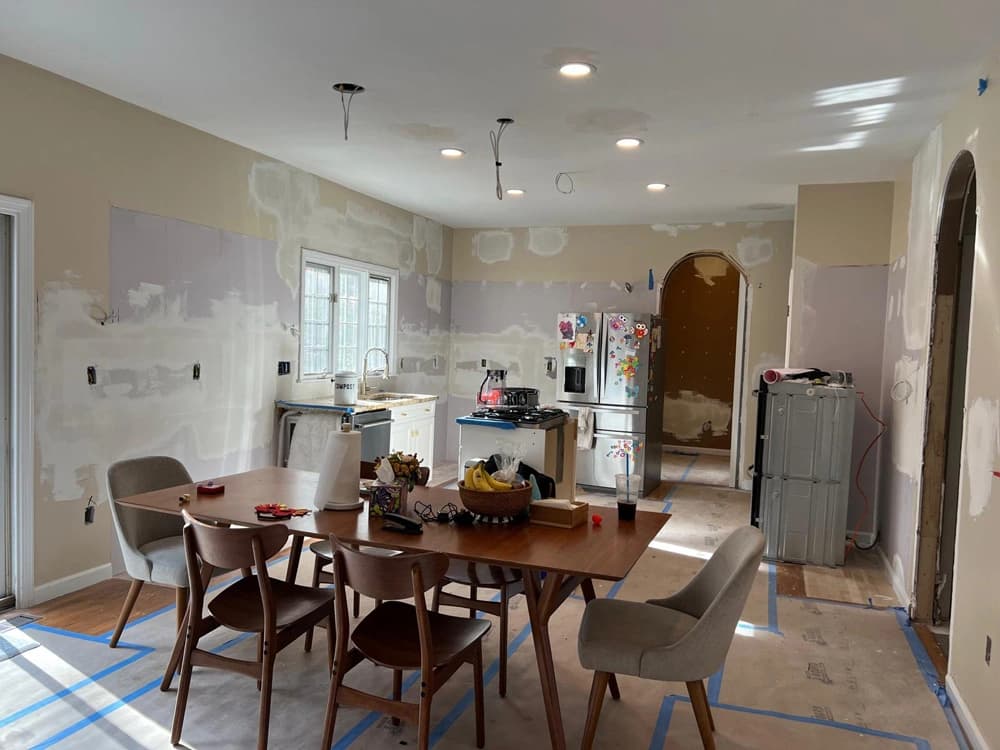
Paint does not hide damage; it highlights it. Cracks, nail pops, dents, old anchor holes, and peeling patches all need to be addressed before painting, and that repair time is a real part of the price.
Older MetroWest homes in Ashland and Framingham sometimes need skim coating over rough or previously repaired plaster to get a smooth result. Water stains require sealing so they do not bleed through the new paint.
The better the prep, the better and longer-lasting the finish. Repairs are not padding on an estimate; they are what makes the final coat look right.
Number of Coats and Color Changes
Two coats is the standard for a uniform, durable interior finish. Some situations call for more, and that changes both time and cost.
Going from a dark wall to a light color, or covering a bold accent, often needs a primer plus two finish coats to fully hide the old color. The reverse, a light wall going slightly darker, can sometimes be done in fewer coats.
Deep and highly saturated colors can also require extra coats to reach full, even coverage, since the tint bases cover differently.
- Standard finish: two coats for even coverage
- Dark to light: often primer plus two coats
- Bold or deep colors: may need an extra coat
- New drywall or bare patches: prime first, then finish coats
How Long an Interior Job Takes
A single room is often a one-day job once prep is done. A whole-home interior commonly runs several days to a couple of weeks, depending on square footage, the amount of repair work, and how many surfaces are included.
Occupied homes take a bit longer than empty ones because the crew works room by room around your furniture and daily life. Extensive patching, skim coating, or multiple color changes also add days.
A clear estimate should give you a realistic day count and a plan for the order rooms are painted, so you know what to expect through the project.
Prep and Furniture Protection
A professional interior job spends real time protecting your home before painting starts. Furniture is moved to the center and covered, floors are protected, and fixtures and hardware are masked or removed.
This protection is part of what you pay for and part of what separates a clean, careful job from a messy one. Good masking also produces sharper paint lines and less touch-up.
Os Pine Painting handles this setup as standard and offers free on-site estimates across MetroWest, so you know the prep, protection, and scope before any work begins.
- Move and cover furniture, protect floors
- Mask or remove hardware, outlets, and fixtures
- Patch, sand, and spot-prime repairs
- Cut in edges and roll two even coats
- Clean up, reinstall hardware, and walk through the finished rooms